Aunt Pooh
On the Come UpAunt Pooh is Brianna Jackson’s aunt, a Garden Heights Gang Disciples member whose bond with Brianna is both a source of opportunity and a point of friction. She helps Brianna find a place in the Ring and encourages her rap ambitions, but her own street life complicates her role as mentor. Her forceful defense of family and her opposition to Brianna’s lyrics reveal a character who can recognize the risks of performing a persona even as she lives within one herself.
Identity and Introduction
Brianna has been visiting the Ring for weeks with Aunt Pooh, who takes her there to learn the setting firsthand. Brianna’s mother, Jayda Jackson, accepts her daughter going to the Ring because Brianna’s father, Law Jackson, battled there and Mr. Jimmy keeps order, but she objects to Aunt Pooh calling herself Brianna’s manager. Their disagreement establishes Aunt Pooh’s contested place in Brianna’s life: she is a relative with access and connections, but Jayda does not regard her as a dependable professional guide.
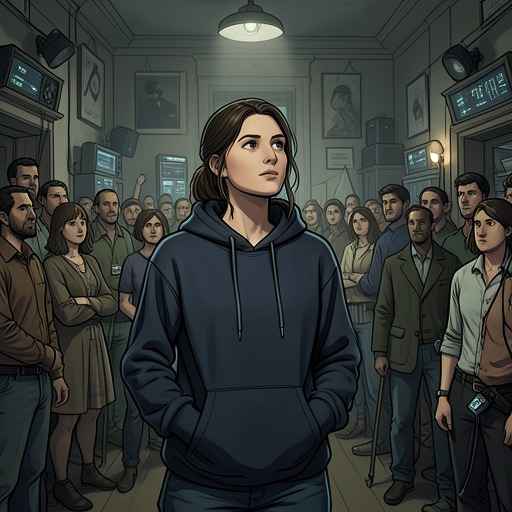
Aunt Pooh arrives with an unmistakable presence. She greets Brianna as a future Ring legend, dancing in green sneakers with green ties on her braids. Brianna identifies the green as a Garden Disciples marker, while Aunt Pooh’s tattoos signal her affiliation; the red lips tattooed on her neck belong to her girlfriend, Lena. These details make her identity legible through style, community symbols, and relationships before her actions reveal how those affiliations shape her choices.
Supporting Brianna’s Rap Ambitions
Aunt Pooh helps Brianna build a small business as well as a stage presence. She buys Brianna’s snack stock and lets her keep the profits, giving Brianna a way to save for real Timberland boots when Jayda will not accept Aunt Pooh simply giving her money. Brianna’s sales at Midtown School of the Arts benefit from the school’s removal of popular vending-machine snacks, turning an everyday restriction into an opportunity. Aunt Pooh’s support is practical and calibrated to the limits Jayda sets around their relationship.
After Brianna’s battle draws attention, Aunt Pooh says that people have contacted her and that she has already made things happen. Her immediate plan is to get Brianna back into the Ring so she can build a name. The offer reflects her confidence in her connections and her sense that a public performance can create momentum. She also understands the force of an audience: as Brianna performs, she recognizes the crowd’s response and joins in when the listeners turn the words into a chant.
That support has limits and competing demands. During the gathering, Aunt Pooh receives a call, says she has business to handle, and leaves Brianna with Scrap rather than staying as she had appeared to promise. The moment gives her help a conditional quality: she can open a door for Brianna, but other obligations can pull her away without explanation.
Family, Conflict, and Responsibility
Aunt Pooh’s loyalty to Brianna is bound up with her loyalty to Law. When a Crown recognizes Brianna as Lawless’s daughter and focuses on her father’s chain, Aunt Pooh moves toward the confrontation; Scrap holds her back. The exchange shows that family history can turn Brianna’s public identity into a source of danger, and that Aunt Pooh responds to an insult against her brother with immediate protectiveness.
That protectiveness becomes explicit after Brianna calls to tell her that someone has pointed a gun at her. Aunt Pooh insists that nobody can come after her family without consequence, citing Law’s death and the threat to Brianna as reasons she cannot let the matter go. Brianna tries to stop her from retaliating, but Aunt Pooh answers by challenging the purpose of the call. Her response exposes the gap between seeking comfort or help and summoning someone prepared to act on anger. The text presents her devotion as real, but also shows how readily it can become a risk to Brianna and to Aunt Pooh herself.
Identity, Performance, and Brianna’s Song
Aunt Pooh challenges Brianna’s lyrics when she hears a song on Brianna’s phone. She tells Brianna that she is not really about the life the song portrays, and Brianna points to Aunt Pooh’s own gun-carrying and drug dealing in reply. The argument is not simply about whether Brianna can rap convincingly. It puts Aunt Pooh’s lived experience beside Brianna’s performance and forces each to confront the difference between describing a life and claiming it as one’s own.
The conflict echoes the advice Brianna receives from Supreme, who argues that artists can use a role without becoming it. Supreme explains that he pushed Law to adopt a street image and to associate with the Garden Disciples for authenticity, and that Law eventually took the performance seriously. His account frames the pressure on Brianna as inherited as well as commercial: she is being offered a version of her father’s career, while Aunt Pooh’s rebuke identifies the danger of presenting a persona as personal truth. At the end of the novel, Brianna’s freestyle rejects being a puppet, a clone, or a figure made to validate other people’s assumptions. That conclusion clarifies the stakes of Aunt Pooh’s earlier challenge without resolving every tension between them.
Narrative Role and Significance
Aunt Pooh occupies an unstable middle ground between advocate and warning. She helps Brianna find an audience, puts money-making support within reach, and reacts fiercely when family members are threatened; at the same time, she can leave abruptly for her own business and urges a response that Brianna is trying to prevent. Her influence is neither wholly safe nor simply harmful. It is part of Brianna’s complicated inheritance from Garden Heights, where family loyalty, street affiliations, public performance, and personal danger repeatedly overlap.